
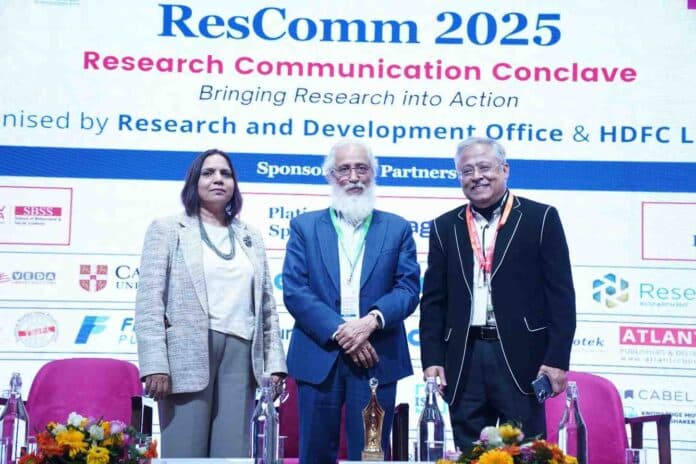
New Delhi: Ashoka University, India’s premier institution for interdisciplinary higher education and research,hosted thethree-day ResComm 2025 Conclaveat its campus, with a focus on strengthening interdisciplinary research communication across the sciences and humanities. The conclave opened with a high-profile inaugural day that brought together leading academics, policy advisors, researchers, and communication specialists to engage with the evolving demands of research dissemination, integrity, and public engagement. The first day saw participation from seniorgovernment, policy, and research stakeholders, includingProf. (Dr) Anil Sahasrabudhe, Chairman, Executive Committee of NAAC; and Chairman, National Educational Technology Forum (NETF) and National Board of Accreditation (NBA);Dr Rajnikant Srivastava, Chair (Disease Elimination), ICMR; andProf. (Dr) K. Vijay Raghavan, Chair, Science Advisory Council, Ashoka University, among others. The conclave commenced with an opening address from Professor Gautam Menon, Dean, Research and featured key sessions on research communication and public engagement, including aplenary chaired by Dr Rajnikant Srivastava, Chair (Disease Elimination), ICMR, examining the challenges and opportunities in communicating health and biomedical research. In a talk focused on healthcare communication,Dr Anurag Agrawal, Dean of BioSciences and Health Research at Trivedi School of Biosciences and Head of the Koita Center for Digital Health, Ashoka Universityemphasised upon the importance of learning to communicate research effectively to diverse audiences and said,“In healthcare, the public in particular is not just looking for information but also for solutions, and effective healthcare research and communication can help bridge that gap.” Delivering the Distinguished Lecture,Prof. (Dr)Anil Sahasrabudhe, Chairman, Executive Committee, NAAC, spoke about India’s rapid rise in research output and the need to now focus on quality and impact.“Over the last 10 years, India has come a long way. In terms of the number of research publications, we are already number three in the world,”he said. Prof. Sahasrabudhe underlined that the country has moved from seventh or eighth place to third in research quantity, but he cautioned that quality remains a concern.“Quantity-wise, we have leapfrogged, but in terms of quality, we have a long way to go,”he said, calling for greater emphasis on high-impact research. He also noted that while India’s patent ecosystem has grown rapidly, much of the work remains at early technology readiness levels. To convert research into usable technologies, he emphasised closer collaboration between universities and industry. Professor Somak Raychaudhury, Vice-Chancellor, Ashoka University, reaffirmed the University’s commitment to nurturing a culture of rigorous research and accessible communication. He shared anecdotes from his on-ground experience of grassroot level communication. He said,“Our ambition at Ashoka is not just to be a leading Research University but to actually contribute actively to the world through global communication, partnering and collaboration.” Prof. K. Vijay Raghavan, Chair, Science Advisory Council, Ashoka Universityremarked “We should invest in research that is curiosity-driven, sparks excitement, and challenges the human mind ensuring that the outcomes of such work are accessible to everyone.” There were sessions on the role of AI and innovation in translating research for policy and public audiences, interactive workshops on Grant Writing, Research Integrity, and Enhancing Research Communication through visuals. The conclave also witnessed the launch ofProductive Failure, authored byProf. (Dr) Manu Kapur, Professor of Learning Sciences and Higher Education at ETH Zurich, Switzerland, and published by Wiley International. The proceedings were led by Dr Shantanu Ganguly, Director of Library at Ashoka University. The book explores learning through struggle and reflection, aligning closely with the conclave’s emphasis on experimentation and effective communication. The conclave concluded successfully, advancing the vision of ethical, interdisciplinary, and impactful research communication.
Ashoka University's ResComm 2025 Conclave Advances Interdisciplinary Research Communication
Indian Education Diary•
Full News
Share:
Disclaimer: This content has not been generated, created or edited by Achira News.
Publisher: Indian Education Diary
Want to join the conversation?
Download our mobile app to comment, share your thoughts, and interact with other readers.