
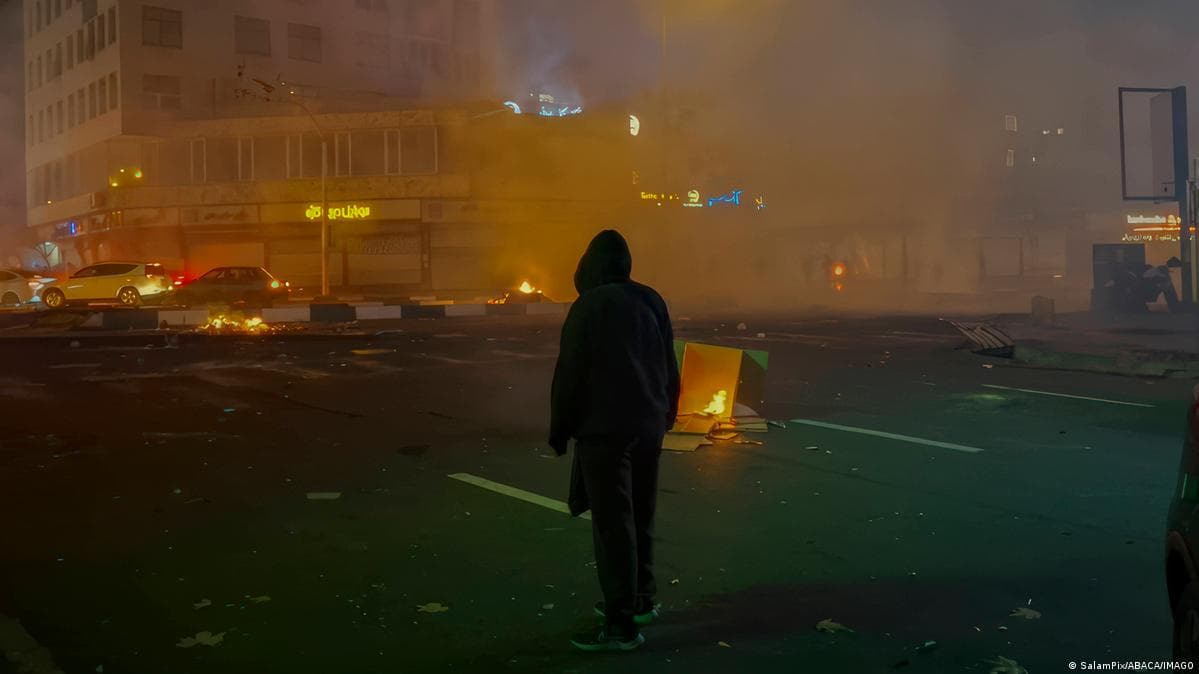
Mass protests,a deepening economic crisisand a tense military standoff with the US have strainedIranianofficials' hold on the Islamic Republic in recent weeks. Asclashes between demonstrators and security forces grew deadly in early January, authoritiesimposed a sweeping communications blackout, making real-time verification of events and reported deaths nearly impossible. While the unrest has since subsided and the blockade was partially lifted, the true scale of the violence and the number of people killed remains unclear. DW spoke with protesters who shared what they witnessed during the unrest on nights of January 8 and 9 in Tehran. All names have been changed to protect the identities of our interview partners. These accounts do not represent the full scope of events nationwide, but can be used to shed light on the government's response. Anti-government resentment in Iran had simmered for a while, fueled by a rapidly deteriorating economy, before first protests erupted in Tehran in late December. To view this video please enable JavaScript, and consider upgrading to a web browser thatsupports HTML5 video Sina, a 29-year-old engineer, said he joined the demonstrations nearly every night after they began. "I would take my car and drive through central parts of Tehran, neighborhoods that are usually hotspots for riots and protests," he said. The pressure on Iran's leadership mounted quickly in early January as protests spread across the country.US President Donald Trump soon started threatening the Iranian leaders with a military intervention. Violent unrest erupted alongside peaceful demonstrations, with government buildings, businesses, mosques and police stations set ablaze. Sina said he was immediately struck by the size of the crowds in Tehran. "The streets were taken over," Sina said. "In some places, people completely blocked a lane and marched. The way people moved together was honestly shocking." Hamid, a 36-year-old teacher, described similar scenes near the City Theater, close to the University of Tehran. "There were rows of soldiers with batons and pellet guns, but they were totally outnumbered," he said. The two eyewitnesses agree that security forces initially focused on dispersing crowds rather than using excessive force. Sina said that this approach may have emboldened more people to join the demonstrations. By January 8 and 9, however, it was clear that "things were beginning to take a violent turn," Sina said. Hamid told DW he witnessed a small group of five or six protesters emerge from an alley, only to be confronted by a larger group of armed security forces who opened fire with pellet guns at close range. "I was shot under my eye that night," Hamid said. "It wasn't until the next day, when the swelling went down, that I realized there was no permanent damage." For Hamid, it seemed the armed forces were trying to intimidate people by acting erratically and frantically. "Several times, I saw them firing blindly toward small crowds," Hamid said. "I'm pretty sure they could have dispersed them without shooting." To view this video please enable JavaScript, and consider upgrading to a web browser thatsupports HTML5 video Both Sina and Hamid — as well as several others DW spoke to — said one noticeable difference from previous protests was the presence of families, as couples, parents and their teenage children often took to the streets together. "I saw groups of people who already knew one another, from different generations," said Fatemeh, a 31-year-old student. "In past years, it was more individuals or groups of friends of same age." Hamid said he observed small groups vandalizing banks and destroying security cameras in several locations, though most protesters did not join them. "Some people tried to stop them," he said. "But I didn't want to approach them, because I didn't know who they were or what they were trying to achieve. Plus, they kind of looked coordinated and ready." Sina described similar groups, noting a clear distinction between them and the broader crowd taking part in the protests. "They knew what they were doing," he said. "They were directing the crowd, moving ahead, setting trash bins on fire, and doing whatever was necessary to block the street. They told cars when and from which direction to pass." "You can't expect an ordinary person to do these things in that kind of terrifying, chaotic atmosphere," he added. To view this video please enable JavaScript, and consider upgrading to a web browser thatsupports HTML5 video Amid competing narratives, it remains unclear who the organized groups were. Iranian officials havealleged that foreign agents were involved in the unrest, citing statements by US and Israeli officials that they say point to the presence of Israel's intelligence service, Mossad, inside Iran. They have described the clashes as part of a US-Israeli "hybrid war" against the country. The narrative was also boosted byTrump publicly voicing support for demonstratorsamid fearsthat the US could launch another attack on Iran. Opposition groups dispute the government claims, saying the individuals may instead have been pro-government agitators tasked with steering protests toward vandalism and mob violence to intimidate and discourage demonstrators. Hamid said he witnessed violence breaking out within groups of protesters. In some cases, he said, demonstrators attacked people they suspected of being security agents in civilian clothes. "One of them was my friend," Hamid said. "He was a protester, but he has a beard, and some people mistook him for a Basij militia member and started beating him. He ended up in the hospital." To view this video please enable JavaScript, and consider upgrading to a web browser thatsupports HTML5 video Hamid said he also saw protesters attacking security forces but stressed that this did not justify the level of force used by authorities. "In most confrontations, the anti-riot forces were the ones initiating the violence," he said. "People were mostly just fighting back." Majid, a 39-year-old taxi driver who joined protests in his eastern Tehran neighborhood, said many teenagers and young demonstrators believed this time the protests would succeed. To view this video please enable JavaScript, and consider upgrading to a web browser thatsupports HTML5 video "They were convinced we were there for victory," he said, adding that some pointed to threats byUS President Trumpas evidence that the Islamic Republic was nearing collapse. "I tried to tell them that's not how things work," Majid said. "They didn't care. One of them said I was being too passive and scared." Majid said he was protesting as well, believing the government responds only to sustained pressure. But he worried that what he described as an oversimplified sense of momentum could push younger protesters toward impulsive actions, including attacks on businesses or banks. "They miss the fact that this is a long game, and want quick gains," he said. "You have to be patient and strategic." Edited by: Darko Janjevic
Iran Protests: Eyewitness Accounts Reveal Violence and Intimidation by Security Forces
DW•
Full News
Share:
Disclaimer: This content has not been generated, created or edited by Achira News.
Publisher: DW
Want to join the conversation?
Download our mobile app to comment, share your thoughts, and interact with other readers.