
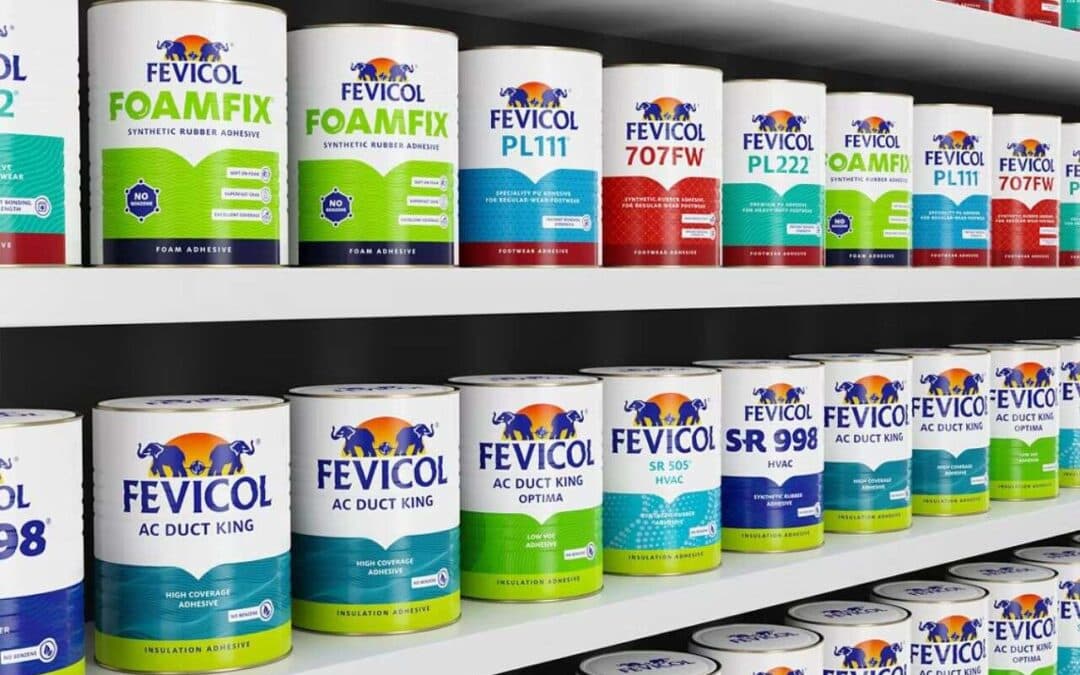
Once known for its iconic Fevicol bottle, the company has undergone significant change. In addition to its traditional adhesives business, the Q1 FY27 results show a more expansive company with new product launches, AI-driven marketing, and growing international subsidiaries. Investor concerns about maintaining domestic innovation and accelerating international expansion in the face of rising raw material costs and geopolitical challenges are raised by this growth, which seems to increase profitability. carried a market capitalisation of approximately Rs 1,71,599.45 crore, with the stock closing on Thursday at Rs.1,686, up 1.26 percent from its previous close of Rs.1,665. It is trading at a P/E of 63.32 times. For the quarter, the company’s product pipeline went far beyond its conventional Fevicol and M-Seal lines. The plumbing industry is the target market for Professional M-Seal Advanced Solvent Cement, which is described as an industry-first water-washable, low-smell formulation that works with CPVC, UPVC, and PVC pipes. Fevicol X-PER targets the high-end woodworking market and is marketed as the brand’s most sophisticated adhesive with an anti-bending feature. Instead of being an extension of Pidilite’s main business, StainOff Wipes, an on-the-go fabric stain solution, enters a category next to it. In terms of marketing, Pidilite is utilising generative AI tools to keep its decades-old brands relevant to a younger, digitally native audience, as evidenced by the Fevikwik AI Pack campaign, which was honoured at the 2026 Kyoorius Creative & Marketing Awards. EBITDA margin increased to 26.3 percent from 25.1 percent in Q1 FY27, while consolidated net sales increased 21.3 percent year over year to Rs 4,541 crore. Due in large part to the inflationary effect of the West Asia crisis on raw material costs, material costs increased by 23.0 percent to Rs 2,118 crore, driving down gross margin by about 90 basis points to roughly 53 percent. Consolidated EBITDA increased 26.9% to Rs 1,194 crore and PAT increased 30.3% to Rs 884 crore in spite of that pressure. Revenue from consumers and bazaars, as reported on a Business-to-Business segment grew 16 percent, with domestic B2B reporting double-digit volume growth of 10.4 percent despite export volumes falling 8.4 percent due to geopolitical disruption. The Consumer & Bazaar (C&B) segment on a standalone basis grew 22.5 percent, with its PBIT margin improving by roughly 58 basis points Advertising and sales promotion expenditures increased by 34.5 percent year over year as a result of the marketing push behind the new product launches and the IPL and film integration campaigns conducted during the quarter, well ahead of the revenue growth of 21.3 percent. The company’s capacity to absorb this increase in spending while reporting a consolidated PAT increase of 30.3 percent indicates that the brand investments are producing returns rather than just raising costs. However, it is important to keep an eye on whether A&SP spending continues to surpass revenue growth in the upcoming quarters because that ratio cannot rise indefinitely without straining margins. For the quarter, overseas subsidiaries reported revenue growth, slightly higher than the 11.5% growth from domestic subsidiaries. Within the international portfolio, the Asia business increased net sales by 16% while EBITDA increased by 40.8%, while the Middle East and Africa business increased net sales by 7.7% but reported EBITDA growth of 106.6%. Although international operations still make up a small portion of the consolidated base compared to the standalone business, profitability at the overseas subsidiaries is clearly growing faster than revenue. This is an early indication that the phase of scale-building is coming to an end and that operating leverage is beginning to emerge. Given management’s own admission that Q1 FY27 margins benefited from carried-forward low-cost inventory along with price increases, a combination that will not repeat indefinitely if raw material inflation persists. Gross margin compression is the most obvious near-term risk. Since a 34.5 percent increase in marketing costs is only sustainable if it continues to translate into volume and pricing gains, it is worthwhile to monitor the rate of A&SP spending in relation to revenue growth. It is important to keep an eye out for indications of a longer disruption rather than a one-quarter blip given the B2B segment’s export weakness, which dropped 8.4% due to geopolitical disruption. Lastly, investors should watch whether Middle East, Africa, and Asia profitability holds up as those subsidiaries scale rather than reflecting a one-time favourable comparison, as the overseas EBITDA surge is encouraging but comes off a small base. Junior Financial Analyst who is pursuing CFA and holds a B.Com (Hons.) degree, with hands-on experience in equity research and stock market analysis at Trade Brains. Actively engages in financial modeling, valuation metrics, market index benchmarking, and regulatory topics while honing skills for top finance roles.
Pidilite Industries Reports Strong Q1 FY27 Results with New Product Launches and International Expansion
Trade Brains•
Full News
Share:
Disclaimer: This content has not been generated, created or edited by Achira News.
Publisher: Trade Brains
Want to join the conversation?
Download our mobile app to comment, share your thoughts, and interact with other readers.