
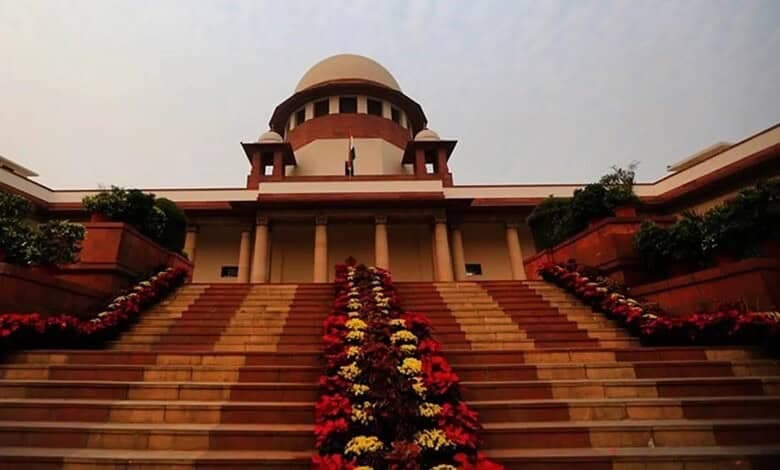
The Supreme Court on Wednesday, September 23, delivered a split verdict on whether a batch of petitions challenging the 2023 law on the appointment of the Chief Election Commissioner (CEC) and Election Commissioners (ECs) should be referred to a larger five-judge Constitution Bench. A bench of Justices Dipankar Datta and Satish Chandra initially disagreed on the issue but ultimately agreed that the matter should be referred to Chief Justice of India Surya Kant to constitute a Constitution Bench of adequate strength. The court noted that referring the issue to a larger bench to determine whether a Constitution Bench is needed would unnecessarily delay the proceedings. The bench noted that sending the issue to a larger bench first would only waste time. While Justice Datta saw no need for a larger bench, Justice Sharma disagreed. Justice Datta expressed doubt over whether the 2023 law of appointing the CEC and ECs provided an independent selection method. He noted that prima facie, the 2023 Act appeared to give the government a veto because a committee of the Prime Minister, a Cabinet Minister and the Leader of the Opposition fails to build public trust in its independence. A person nominated by the Prime Minister cannot be expected to vote against the PM, Justice Datta observed. “Free and fair elections depend on a truly independent ECI. It is not enough for the ECI to be independent; it must appear to be independent,” he said. The member nominated by the Prime Minister cannot be expected to defy the Prime Minister, he added. Justice Datta asked if the inclusion of Cabinet Ministers in the process provided a fair balance to the executive government. “Inclusion of Cabinet Ministers fails to provide an independent counterweight that a neutral selector would. It becomes largely ornamental.” The judge said the law laid down in Anoop Baranwal in 2023 by a five-judge bench that the Election Commissioners must be appointed through a process free from executive influence remains intact, even if the PM, CJI and LoP committee itself was a temporary solution until Parliament passed a law. In opposition, Justice Sharma said the issue has to be decided by a Constitution Bench as per Article 145(3) of the Constitution. Even with differing views on sending the case to a Constitution Bench, the two-judge bench ultimately asked the CJI Kant to form one to prevent any delay. In July, the apex court had reserved its verdict on whether the issue should be sent to a Constitution Bench. The judgment was delivered while hearing a group of petitioners challenging the 2023 Act, which governs how the Chief Election Commissioner and Election Commissioners are appointed. The petitioners had flagged the problem of the Selection Committee, which gave the executive a two-to-one majority, undermining the independence of the EC. The Centre, in response, sought a reference to a larger bench, contending that the claims raise important questions about the interpretation of Article 324 ( Superintendence, direction and control of elections to be vested in an Election Commission ) and the scope of Parliament’s power to order the appointment of Election Commissioners. The petitioners argued Parliament could pass an appointment law, but not one giving the government total control over selections.
Supreme Court Delivers Split Verdict on Election Commissioner Appointments
Siasat News•
Full News
Share:
Disclaimer: This content has not been generated, created or edited by Achira News.
Publisher: Siasat News
Want to join the conversation?
Download our mobile app to comment, share your thoughts, and interact with other readers.