
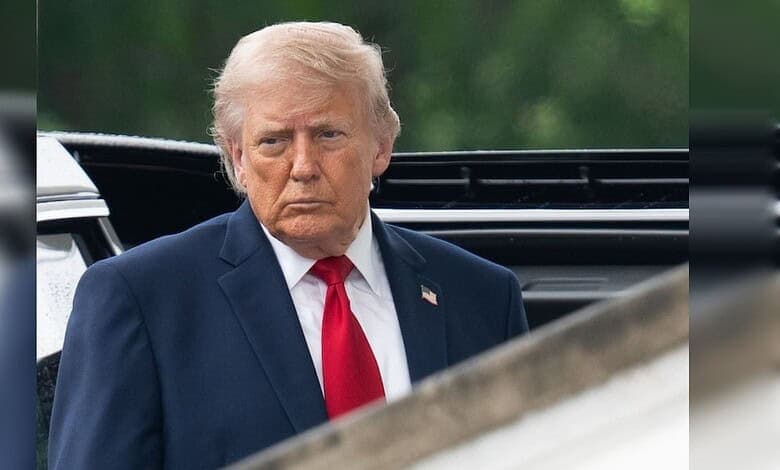
On the 36th day after the signing of the memorandum of understanding between Washington and Tehran, and 145 days since the outbreak of the war on Thursday, July 23,, US President Donald Trump’s latest remarks appeared to portray Iran’s nuclear programme as non-military, triggering debate as regional tensions continued to escalate. In a Truth Social post, Trump announced that a proposed civil nuclear agreement between the United States and Saudi Arabia would involve “no enrichment of material” and would be limited to peaceful purposes. “The Civil Nuclear Deal (There will be no enrichment of material!) being made between the United States Department of Energy and Saudi Arabia, which pertains only to non-military use such as the ones that Iran and UAE (and others) already have, will be approved,” he wrote. The wording drew attention because some interpreted the remarks as suggesting Trump was describing Iran’s nuclear programme as civilian rather than military in nature. Others argued he was referring to civilian nuclear programmes already operated by Iran, the United Arab Emirates (UAE) and other countries, while the “no enrichment” condition applied specifically to the proposed Saudi agreement. Trump also said Saudi Arabia would need to join the Abraham Accords before the proposed nuclear agreement could proceed. Qatar Airways has temporarily suspended flights to Bahrain, Kuwait and Erbil, according to a travel advisory issued by the airline. The carrier said services to Bahrain (BAH) and Erbil (EBL) will remain suspended until and including July 25, 2026. Flights to Kuwait (KWI) will remain suspended until , it added. The airline did not provide a reason for the suspensions in the advisory. United Nations Secretary-General António Guterres has warned that the escalating conflict across the Middle East has pushed the region to the “edge of the unimaginable”, cautioning that the continuing cycle of violence risks spiralling further out of control. Addressing a meeting of the UN Security Council, Guterres said the region was being drawn into an increasingly dangerous pattern of confrontation, with each crisis fuelling the next. “The situation is getting out of control. It is teetering on the edge of the unimaginable. The region is being pulled into an ever-widening circle of confrontation. One crisis feeds another. One escalation triggers the next,” he said. Guterres added that as tensions continue to spread, the original political objectives behind the conflicts are becoming increasingly overshadowed by the confrontations themselves. “As this dynamic spreads, the political objectives are becoming increasingly obscured by the confrontation itself,” he told the Council. US Secretary of State Marco Rubio said Iran was not serious about reaching an agreement despite privately seeking talks, as fighting continued across the Middle East and diplomatic efforts remained stalled. Speaking to reporters on the sidelines of the Association of Southeast Asian Nations (ASEAN) foreign ministers’ meeting in Manila, Rubio claimed Iran had approached the United States through both direct and indirect channels to negotiate an end to the conflict. “Iran is begging us, both directly and indirectly, ‘Let’s do a deal. Let’s talk,'” Rubio said. He accused Tehran of repeatedly reneging on previous agreements. “The problem with Iran is every time they make a deal, the people in charge either break it or they want to change it,” Rubio said. “So it looks like they’re not ready to make a deal, so they’re going to continue to pay a price, and every night the price gets higher and higher.” Rubio said the United States had honoured its commitments while Iran continued to violate agreements despite suffering significant losses. He reiterated that Washington’s primary objective remained preventing Iran from acquiring a nuclear weapon and accused Tehran of directing its resources towards Hezbollah, Hamas, the Houthis and Shia militias instead of addressing domestic economic challenges. Responding to Iranian officials’ “an eye for an eye” remarks, Rubio said President Donald Trump’s approach was “a head for an eye”, warning that Iran would continue to pay a “very heavy price”. He also claimed Iran’s industrial infrastructure was being heavily damaged, resulting in billions of dollars in losses. Rubio rejected suggestions that Russia had assisted Iran’s weapons programmes and urged Yemen’s Houthi movement to stop targeting Saudi-linked shipping. US President Donald Trump warned that Iran would be held responsible for any future attacks by Yemen’s Houthi movement after the group claimed to have targeted two Saudi-linked oil tankers in the Red Sea. Describing the Houthis as “a surrogate and/or proxy of Iran”, Trump said the United States had struck the group “very powerfully” about a year ago and claimed it had since “acted very responsibly”. “Unfortunately, now they are starting up again, shooting at two Saudi Arabian ships last night,” Trump said. He warned that any further attacks would prompt a US response against both Iran and the Houthis. “If they do this again, the US will hold Iran responsible, in that the Houthis are a surrogate and/or proxy of Iran, and major military punishment will be inflicted upon Iran and, of course, the Houthis themselves,” he said. Iranian Foreign Minister Abbas Araghchi said the obstacle to diplomacy was Washington’s approach rather than the absence of communication. He said there was no need to exchange messages with the United States, as intermediaries were already available to facilitate contacts. “Washington must realise that there is no other way but to respect the Iranian people and their national interests,” Araqchi said. He added that the main barrier to any agreement was what he described as Washington’s “illogical approach and excessive demands”, saying Iran had responded with a firm stance. Iran’s Foreign Ministry spokesman Esmaeil Baghaei accused the United States of advocating actions that would violate international humanitarian law after President Donald Trump threatened to destroy “one bridge or power plant” for every Iranian attack on commercial shipping in the Strait of Hormuz. In a post on X, Baghaei said attacks on civilian infrastructure would amount to war crimes and unlawful collective punishment. He argued that citing superior orders does not absolve individuals of criminal liability and said US service members have both a legal and moral duty to refuse manifestly unlawful orders. Baghaei cited the US War Crimes Act, the Uniform Code of Military Justice and the US Department of Defense Law of War Manual, adding that Iran would remain “firm and resolute against lawlessness and the flouting of the law.” Iran’s Islamic Revolutionary Guard Corps (IRGC) claimed responsibility for attacks on US military facilities in Kuwait and Jordan. The group said it struck Ali Al Salem Airbase in Kuwait, claiming to have destroyed a military equipment warehouse, a Patriot air defence system and a hangar housing MQ-9 drones. In a separate statement, the IRGC claimed it destroyed a THAAD missile defence radar, a Patriot system and a C-RAM radar at a US military base in Jordan. It also claimed to have set fire to fuel tanks, a helicopter equipment warehouse and a helicopter maintenance site. The claims have not been independently verified. Jordan’s armed forces said air defence units intercepted four missiles and six Iranian drones that entered the kingdom’s airspace. According to the Jordan News Agency, three missiles were intercepted while a fourth landed in a remote, uninhabited area. The military also said six drones were shot down overnight, with no casualties or material damage reported. Kuwait’s military separately said its air defences intercepted hostile drones following what it described as Iranian aggression. Meanwhile, Iranian army spokesman Brigadier General Amir Mohammad Akraminia warned that Tehran would adopt “new strategies and scenarios” if US attacks on Iran’s southern infrastructure continued. The IRGC warned that continued US interference with maritime traffic in the Strait of Hormuz would result in an “irreparable defeat”. The statement came after an oil tanker caught fire while attempting to transit the strategic waterway, while two other tankers reportedly turned back following the incident. Oman’s Ministry of Foreign Affairs said it was closely monitoring developments in the Red Sea and stressed the need to avoid further escalation that could threaten freedom of navigation. The ministry said it was coordinating with Saudi Arabia, the Yemeni parties and the UN Special Envoy for Yemen to resume the political process and implement a roadmap aimed at restoring regional security and stability. Bahrain’s Ministry of Interior activated warning sirens across the country, urging citizens and residents to remain calm, move to the nearest safe location and follow updates through official channels. US Central Command (CENTCOM) said its forces carried out another round of strikes against Iran, marking the 12th consecutive night of military operations. The command said US forces targeted Iranian maritime capabilities, missile and drone storage facilities, coastal surveillance sites and air defence assets to further degrade Tehran’s ability to attack civilian mariners and commercial vessels. CENTCOM added that US forces have struck dozens of Iranian military targets this month while maintaining a maritime blockade against Iran. It said nine commercial vessels had been redirected and one disabled to prevent ships from entering or departing Iranian ports. The command also said more than 50,000 US service members remain deployed across the Middle East and are “highly vigilant, focused, lethal and ready”. Oil prices rose for a fifth consecutive session amid concerns over potential supply disruptions. Brent crude climbed 2.6 per cent to USD 96.49 a barrel, while US West Texas Intermediate crude rose 1.8 per cent to USD 88.42. President Donald Trump paid tribute to four US service members killed in the Middle East, with the White House saying their “service, courage and sacrifice will never be forgotten”. The personnel were identified as 1st Lt. Tyler Feehan, Sgt. Michael Swinton, Sgt. Angel Rampersad and Pvt. Isabella Gonzales. The White House said more than 50,000 US troops remain deployed across the region. Britain temporarily withdrew its remaining diplomatic staff from Iran because of the deteriorating security situation. The UK’s Foreign, Commonwealth and Development Office (FCDO) said the embassy would continue operating remotely while maintaining its advice against all travel to Iran. It also urged British nationals in the country to carefully consider the risks of remaining there.
US President Trump's Remarks on Iran's Nuclear Program Spark Debate Amid Escalating Regional Tensions
Siasat News•
Full News
Share:
Disclaimer: This content has not been generated, created or edited by Achira News.
Publisher: Siasat News
Want to join the conversation?
Download our mobile app to comment, share your thoughts, and interact with other readers.